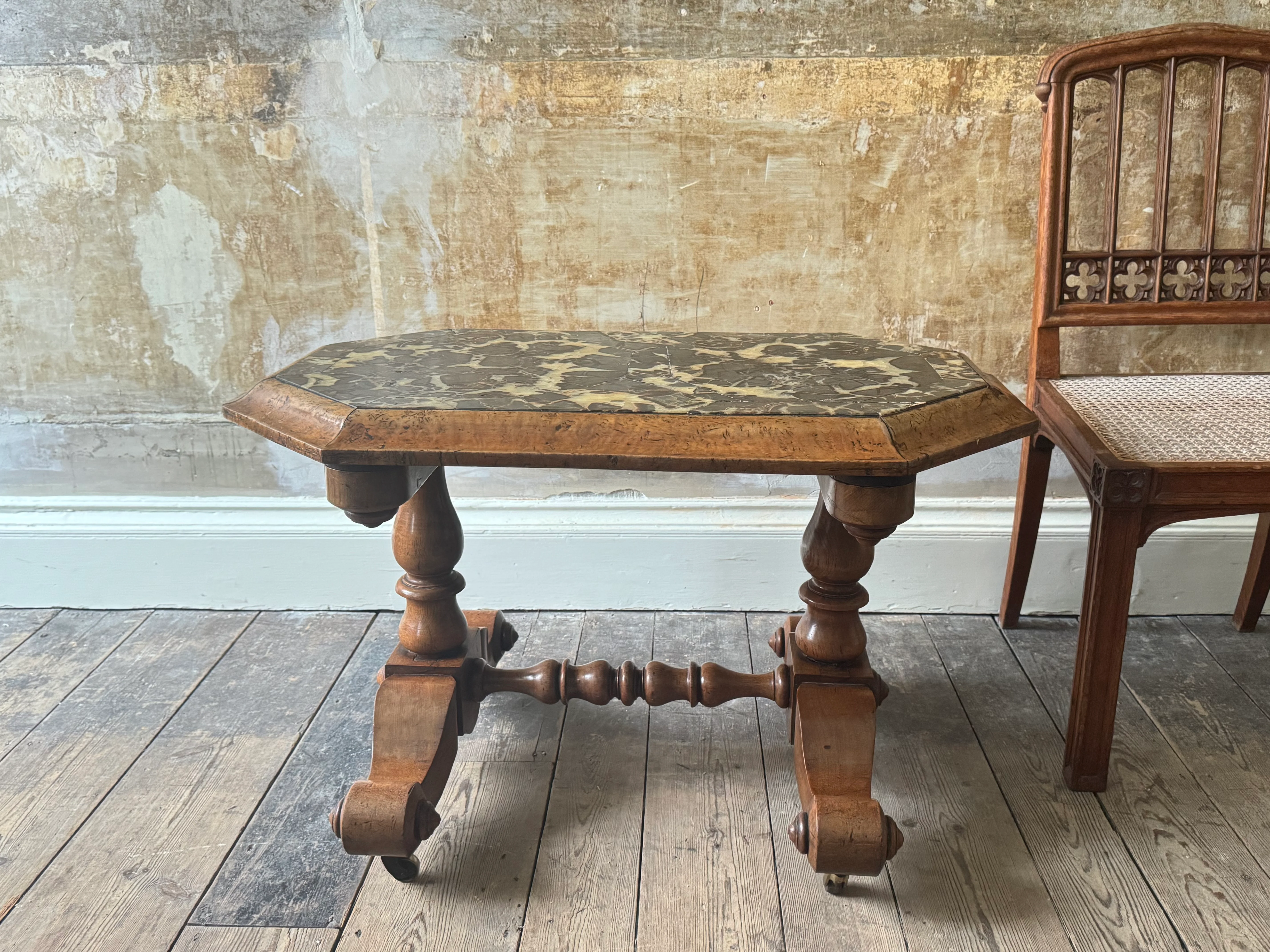
A 19th Century Burr Oak & Turtlestone Marble Table
The elongated octagonal top inset with turtlestone marble, moulded burr oak frame, turned oak supports and stretcher, sled feet raised on brass castors.
English, circa 1840.
Height 20in (51cm).
Lenght 32in (81.5cm).
Depth 19in (48.5cm).
Septarian Nodule marble, more commonly known as ‘turtle-stone’ because of its grey-green, brown and yellow colouring and shell-like pattern.
Septarian Nodule marble was formed by soil deposits that dried out, the cracks that were created were filled with Calcite crystals (created from crushed seashells). The marble first began to be cut, polished and inset into furniture in the 19th Century Britain.
The elongated octagonal top inset with turtlestone marble, moulded burr oak frame, turned oak supports and stretcher, sled feet raised on brass castors.
English, circa 1840.
Height 20in (51cm).
Lenght 32in (81.5cm).
Depth 19in (48.5cm).
Septarian Nodule marble, more commonly known as ‘turtle-stone’ because of its grey-green, brown and yellow colouring and shell-like pattern.
Septarian Nodule marble was formed by soil deposits that dried out, the cracks that were created were filled with Calcite crystals (created from crushed seashells). The marble first began to be cut, polished and inset into furniture in the 19th Century Britain.
Original: $3,139.00
-70%$3,139.00
$941.70Description
The elongated octagonal top inset with turtlestone marble, moulded burr oak frame, turned oak supports and stretcher, sled feet raised on brass castors.
English, circa 1840.
Height 20in (51cm).
Lenght 32in (81.5cm).
Depth 19in (48.5cm).
Septarian Nodule marble, more commonly known as ‘turtle-stone’ because of its grey-green, brown and yellow colouring and shell-like pattern.
Septarian Nodule marble was formed by soil deposits that dried out, the cracks that were created were filled with Calcite crystals (created from crushed seashells). The marble first began to be cut, polished and inset into furniture in the 19th Century Britain.